
Measurement
Mentions, citations and clicks: what a ChatGPT dashboard cannot tell you
A number from the platform feels authoritative, and it is, about the one thing it counts. The trouble starts when that one thing gets read as the whole picture of how you look in AI answers.
On this page
Why are mentions and citations different things?
When an assistant answers a question it can do two separate things. It can write your brand name into the sentence, and it can list one of your pages as a source. Either can happen without the other. A page can sit in the source list while the answer talks about someone else, and a brand can be named from memory with no link at all.
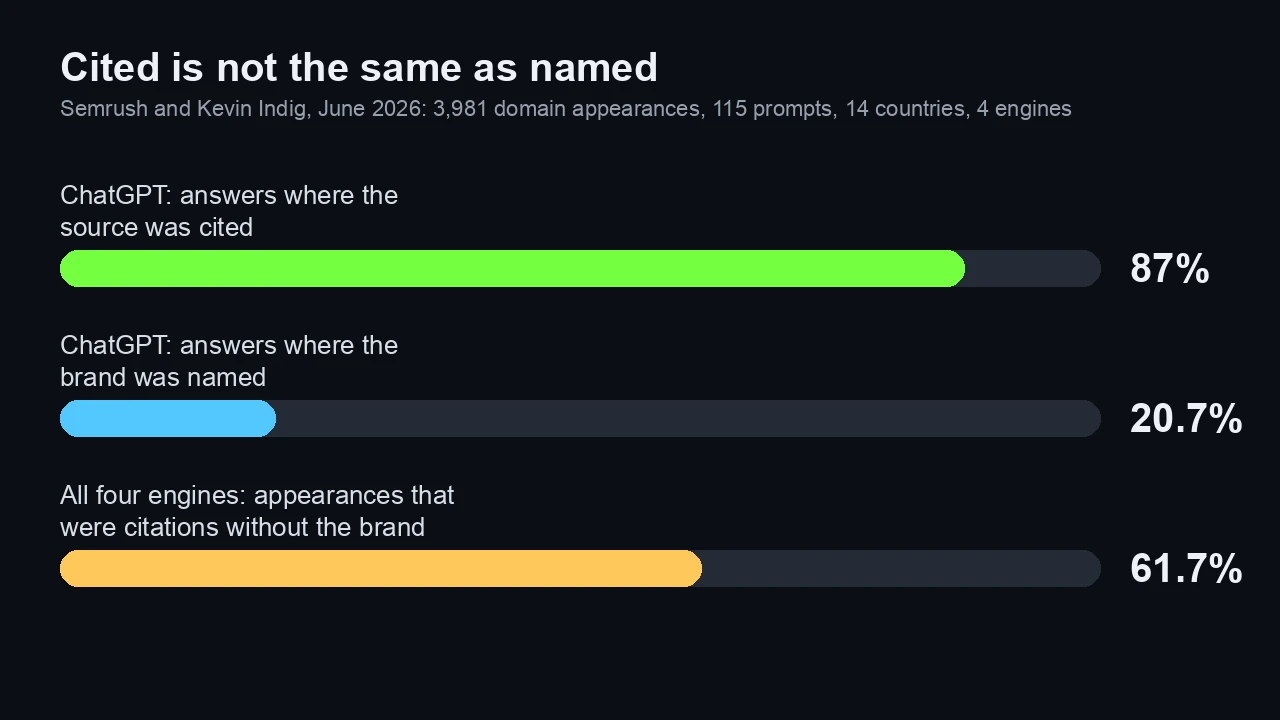
That gap is bigger than most teams expect. A study published by Semrush with Kevin Indig in June 2026 looked at 3,981 domain appearances across 115 prompts, 14 countries and four AI engines. About 61.7 percent of appearances were citations with no brand name in the answer. For ChatGPT specifically the study reported a citation rate of 87 percent against a brand mention rate of 20.7 percent.
What does a platform report count, and what does it miss?
The Business Hub, as reported, counts a mention for an online business when ChatGPT references the site, and counts clicks sent to it. That makes it a record of source use and traffic for your own business. It will not tell you the times you were named without a link, or the times a competitor was named and you were not, because it shows neither prompts nor rivals.
Be careful with the share of answers that carry no source at all. DataForSEO reports that 27.3 percent of the ChatGPT answers it analysed had no citations, against 0.7 percent for Google AI Overviews, but the public page gives no sample size, country or method for that figure. Similarweb has published a very different citation rate for ChatGPT prompts, which shows the two use different denominators. Do not put such numbers side by side or build a plan on one of them.
Related reading: How to measure AI visibility (a practical method) and ChatGPT business profiles explained: what launched and what is missing.
Why does one check tell you almost nothing?
Generated answers vary. Ask the same question twice and you can get different brands, different order and different sources. Researchers who repeated prompts many times found that the exact list of brands rarely repeated, while the chance that a given brand appeared at all was more stable than its position. So the useful quantity is how often you appear across many runs, not where you ranked in one.
The route an answer takes matters as well. An observational preprint on arXiv, using 34,960 observations, reported GPT mention rates of 2.8 percent when the brand's own domain was not part of the retrieved evidence, 49 percent when its domain was cited, and 91.4 percent when it was cited and the search also used branded sub-questions. It is correlational, so it shows an association and not a recipe, but it points the same way as the study above: being retrieved is the first gate to being named.
How do you build a measurement that holds up?
Fix a prompt set that mirrors how buyers ask, split into branded questions, category questions and comparison questions, and add the geography you sell in. Run each prompt several times per cycle, on the same day of the week, because a single run is an anecdote. Studies in this area have used from ten to a hundred runs per prompt, and there is no agreed standard, so choose a number, state it and keep it.
For every answer record four things separately: whether your brand was named, whether your own domain was cited, whether only third-party pages were cited, and which competitors were named. Then report share of voice with its sample size and a plausible range. A move from 14 to 17 percent on twelve observations is noise, and the same move on three hundred is worth acting on.
Date-stamp every run. The mix of sources shifts from month to month, and a number with no date cannot be compared with next quarter's.
What actually moves the numbers, and what is folklore?
Be sceptical of recipes. The one controlled test we found came from Ahrefs in May 2026: it compared about 1,885 pages that gained structured data with roughly 4,000 comparison pages and found a 2.2 percent change in ChatGPT inclusion that was statistically indistinguishable from zero. Structured data still helps other things, but do not expect it to be a lever for ChatGPT on its own.
What has better support is plainer. Pages must be fetchable by OpenAI's search crawler. Your key facts should sit in clear text on pages that can be read without scripts. And other sites should describe you accurately: in Ahrefs' study of 75,000 brands, branded web mentions correlated most strongly with appearing in ChatGPT, at 0.664, though correlation is not cause. None of this is a quick trick, which is part of why it works.
Where does OClever fit?
OClever runs the sampled-prompt method described above across the major AI engines, records mentions, citations and competitor names per answer, and keeps the answers behind each number so you can open them. It also reads your own crawler logs and Search Console data, which covers the parts a platform's own report cannot see. If you already use the Business Hub, treat it as one input next to that, not a replacement for it.
Frequently asked questions
What is the difference between a mention and a citation in ChatGPT?
A mention is your brand named in the text of an answer. A citation is one of your pages listed as a source. One can happen without the other.
How many times should I run each prompt?
Several times per cycle. Published studies used between ten and a hundred runs, and no standard exists, so pick a number, state it and keep it constant.
Does structured data make ChatGPT mention my brand?
The one controlled test we found, by Ahrefs in May 2026, found no statistically meaningful effect on ChatGPT. It still helps in other search surfaces.
Can the Business Hub replace third-party tracking?
No. As reported it shows only your own mentions, clicks and discovery topics, with no prompts, competitors or other AI assistants.
Is the 27.3 percent no-citation figure reliable?
DataForSEO reports it, but the public page gives no sample or method, so treat it as indicative and do not compare it with other studies' rates.
Sources
- Semrush and Kevin Indig, study of citations without brand mentions, 9 June 2026
- arXiv 2609.23162, retrieval path and brand mention rates in ChatGPT, September 2026 (observational preprint)
- Ahrefs, structured data test on AI inclusion, May 2026, and study of 75,000 brands, December 2025
- DataForSEO, Search Insider 2026 (method not published on the public page)
- OpenAI developer documentation, crawlers and user agents
- Launch coverage of the Business Hub, 10 to 11 November 2026
Keep reading
Part of our Measurement series. Start with How to measure AI visibility (a practical method).
See it on your own brand: Visibility tracking in OClever, or book a demo.