

Research
ChatGPT business profiles explained: what launched and what is missing
For the first time a business can tell ChatGPT who it is, in its own words, and see a few numbers about how often it shows up. The numbers are useful and also thin, and knowing the difference matters more than rushing to sign up.
On this page
What did OpenAI launch on 10 November?
The launch has three parts that work together. The first is a business profile: a verified page for your company inside ChatGPT, where you control the details that the assistant can draw on. The second is a product feed, a structured file of your items with prices and availability. The third is the Business Hub, a dashboard reachable from the ChatGPT sidebar that reports how often your business appeared and what happened next.
A fourth piece sits on top for a narrower group. Business Agents are labelled assistants that answer shoppers' questions about a company's products and policies. According to launch coverage in VentureBeat and Digiday, publishing one is limited at the start to eligible US ecommerce and online-service businesses, and OpenAI has promised more markets and categories without giving dates.
Everything here is a beta. The details in this article come from launch-day press coverage, because OpenAI's own announcement could not be opened when we wrote it. Treat any specific limit as something that may move in the coming weeks.
What does the Business Hub actually report?
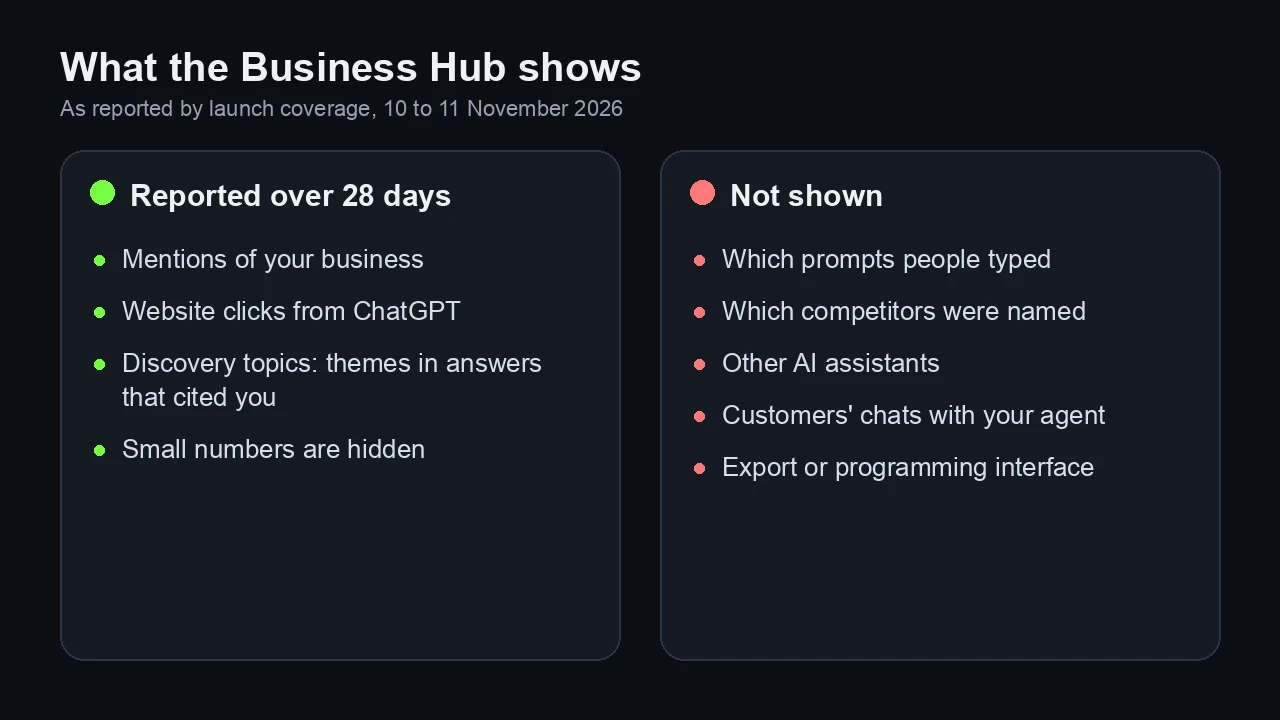
Reports describe three measures over a rolling 28-day window. Mentions count the times ChatGPT referred to your business. Clicks count visits sent to your website. Discovery topics list the themes that tend to appear in answers that cited you, which gives a rough sense of what people were asking when you came up.
The definition of a mention is where care is needed. For an online business, coverage says a mention is recorded when ChatGPT references the business's website, so an answer that names your brand without linking to your site does not appear to count. For a local business, a mention is a location result being shown. Numbers below a privacy threshold are not shown, so an empty chart does not prove nothing happened.
Clicks are also easy to over-read. A click is a visit sent from ChatGPT, not a sale, and it will not match your own analytics exactly. The sensible move is to put the Hub's click count next to the same window in Google Analytics and treat any gap as a question to investigate, not a fault.
Related reading: How to claim and set up your business on ChatGPT, step by step and Mentions, citations and clicks: what a ChatGPT dashboard cannot tell you.
What does it leave out?
The tool is built around your own business. It does not show which questions people typed, which competitors were named beside you, how you were described or what other AI assistants say about you. OpenAI also does not pass on users' conversations, and merchants cannot read what customers said to a Business Agent.
There is no export or programming interface mentioned in coverage, no dispute process spelled out for wrong information, and no timeline for countries outside the launch scope. Digiday's reporting described the data as far thinner than what Google gives advertisers and argued that the tool serves OpenAI's own advertising plans at least as much as it serves merchants.
None of that makes the Hub useless. It is a free, first-party signal from the platform itself, and that has real value. It just answers one narrow question, how often did ChatGPT send people to my site, and leaves the larger question of how you compare with everyone else unanswered.
How does this compare with Google and Bing?
Several outlets compared it with Google Business Profile combined with Search Console, which is a fair first impression: you claim an identity and then see a small set of performance numbers. What is new is that it lives inside a general-purpose assistant rather than a search engine, and that a company can run its own agent there.
What is not new is feed ingestion. Google Merchant Center, Microsoft Merchant Center and Perplexity's merchant programme already take product data. The closest existing report to the Hub is probably the AI Performance report in Bing Webmaster Tools, which went into preview in February 2026 and added topics, citation share and comparison views in June, according to coverage at the time.
One more piece of context from TechCrunch: OpenAI's earlier shopping push, which took a commission on sales made inside ChatGPT, was reportedly retired in March 2026. The Business Hub looks like a discovery layer instead, where the purchase happens on the company's own site.
Where do ads come into it?
Press coverage says a business can sponsor its agent, so that it becomes a destination for ChatGPT Ads. VentureBeat describes this as a limited test with selected advertisers, and pricing has not been described. OpenAI says ads are labelled and kept apart from ChatGPT's own answers.
Whether paying changes what ChatGPT recommends is, for now, only OpenAI's statement to rely on. Its monetisation chief reportedly said that claiming a profile should not change how often a business appears, though supplying accurate information may help the business surface in more relevant conversations. That is a reasonable thing to remember when someone tells you to claim your profile before a competitor does.
What should a brand do this week?
Start with a cheap audit. Ask ChatGPT a dozen questions a buyer would ask in your category, with and without your brand name, and write down what it says about you and who it names. This takes an afternoon and tells you more about your starting point than any dashboard.
Then decide whether you are eligible and worth the effort. If you have a website and a catalogue, claiming costs nothing but time, and the verification route (phone, email, a DNS record or a Shopify connection) is described in our setup guide. Keep your feed consistent with your own site, and do not expect a visibility jump.
Finally, plan to measure outside the Hub. It reports your clicks, not your standing against rivals. A repeatable prompt set, sampled several times, is what shows whether you are being named at all. Our piece on mentions, citations and clicks explains how to build one.
Frequently asked questions
What are Businesses in ChatGPT?
A beta from OpenAI, launched on 10 November 2026, that lets eligible businesses claim and verify a profile, add product feeds, read a 28-day Business Hub report and, for some US businesses, publish a labelled agent.
Is it free?
Press reports say claiming and managing a profile and publishing an agent are free for now, and that OpenAI has not ruled out charging later. Sponsoring an agent through ChatGPT Ads is separate and paid.
Will claiming a profile make ChatGPT mention my business more?
OpenAI's own line, as reported, is that it should not change how often a business appears. Accurate profile and feed data may help it surface in relevant conversations, but nothing is promised.
Does the Business Hub show which prompts or competitors?
No. Coverage says it shows aggregate mentions, clicks and discovery topics for your business only, with small numbers hidden.
Who can publish a Business Agent?
At launch, eligible US ecommerce and online-service businesses. OpenAI has said more markets and categories will follow without dates.
Sources
- OpenAI, Introducing Businesses in ChatGPT, 10 November 2026 (details here are as relayed by the press coverage below)
- VentureBeat and Digiday launch coverage, 10 to 11 November 2026
- TechCrunch and The Next Web launch coverage, 10 to 11 November 2026
- Search Engine Roundtable, ChatGPT business profiles, November 2026
- Bing Webmaster Tools, AI Performance report announcements, 2026
Keep reading
Part of our Research series. Start with How ChatGPT, Gemini, Perplexity, Claude and Google AI build an answer.


See it on your own brand: Visibility tracking in OClever, or book a demo.